When people think about successful long-term investing, they often focus on finding “great investments.” While qualitative factors certainly matter, experienced investors know that what you pay for an investment can be just as important as the investment itself. This is where valuation metrics come in. Understanding valuation helps investors determine whether an asset is reasonably priced, overpriced, or potentially undervalued—an essential skill for building wealth over time.
Price Matters More Than Many Investors Realize
Valuation metrics help investors answer a fundamental question: Is this asset worth the price being asked today?
Without these tools, investors risk relying on hype, momentum, or emotional decision-making rather than disciplined analysis.
Over long-time horizons, valuations tend to play a major role in determining investment outcomes. Stocks purchased at extreme valuations often struggle to deliver strong future returns, while those bought at more attractive prices have a larger margin of safety.
The Concept of Margin of Safety
One of the core ideas behind valuation analysis is the concept of a margin of safety. This principle suggests investors should buy securities at prices below their estimated intrinsic value.
Doing so helps protect against errors in analysis, unexpected economic shifts, or temporary business challenges. When investors pay too much for an asset, even small disappointments can lead to substantial losses.
By focusing on valuation, long-term investors build a buffer that reduces downside risk while augmenting upside potential.
Valuation and Long-Term Returns
History repeatedly shows that starting valuations influence future returns. Periods when markets trade at extremely high valuations often produce lower returns in subsequent years, while periods of low valuations frequently precede stronger long-term performance.
This doesn’t mean investors can perfectly time the market. However, maintaining awareness of valuation levels can help guide decisions about how aggressively to deploy capital, what asset classes to favor, and when to exercise patience.
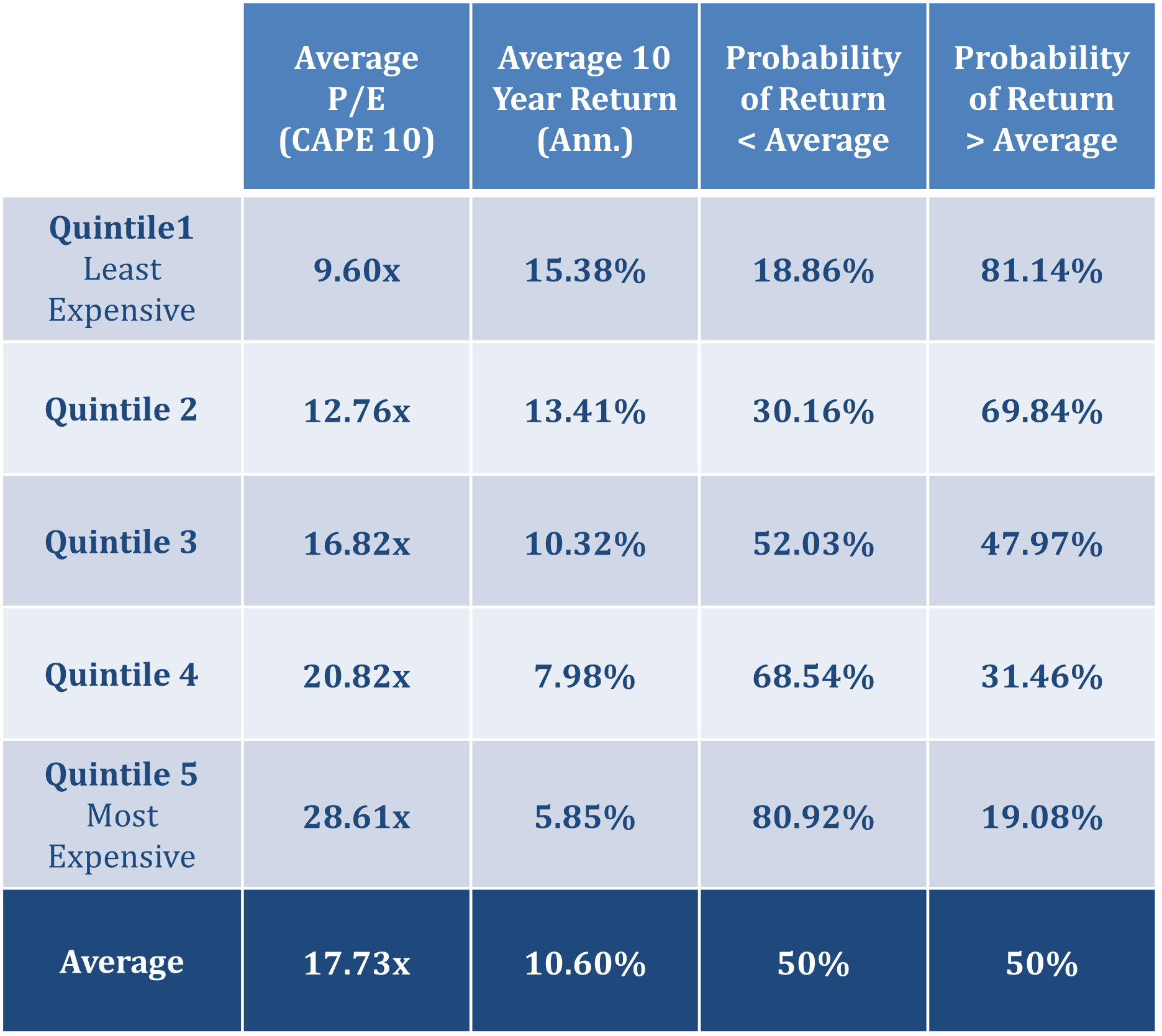
Sources: S&P, iCM Index performance returns do not reflect any management fees, transaction costs or expenses. Indexes are unmanaged and one cannot invest directly in an index Past Performance is no guarantee of future results. Probabilities are calculated based upon the statistical relationship between the beginning CAPE ratio of the S&P 500 and subsequent 10-year annualized returns. Analysis period runs from January 1926 through December 2025.
Final Thoughts
Successful long-term investing is not about chasing the hottest stocks or predicting short-term market movements. Instead, it relies on disciplined decision-making and a focus on fundamental value.
Valuation metrics provide a structured framework for determining whether an investment offers an attractive risk-reward profile. While they are not perfect predictors, they help investors avoid overpaying and identify opportunities where the market may be mispricing an asset’s true potential.
In the long run, investors who consistently pay attention to valuation—and maintain patience and discipline—are far more likely to build lasting wealth.
Disclosures
Integrated Capital Management, Inc. is an SEC Registered Investment Advisor. Registration does not imply any certain level of skill or training. This blog is intended solely to report on various investment views held by Integrated Capital Management. Opinions, estimates, forecasts, and statements of financial market trends that are based on current market conditions constitute our judgment and are subject to change without notice. We believe the information provided here is reliable but should not be assumed to be accurate or complete. References to specific securities, asset classes and financial markets are for illustrative purposes only and do not constitute a solicitation, offer or recommendation to purchase or sell a security.
Past performance is no guarantee of future results. Please note that investments in foreign markets are subject to special currency, political, and economic risks. Index performance returns do not reflect any management fees, transaction costs or expenses. Indexes are unmanaged and one cannot invest directly in an index. Where applicable, portfolio characteristics are shown gross of fees.
Any capital markets views are intended solely to report on various investment views held by Integrated Capital Management. Opinions, estimates, forecasts, and statements of financial market trends that are based on current market conditions constitute our judgment and are subject to change without notice. We believe the information provided here is reliable but should not be assumed to be accurate or complete. References to specific securities, asset classes and financial markets are for illustrative purposes only and do not constitute a solicitation, offer or recommendation to purchase or sell a security. Outlook may change at any time given shifting market conditions. Past performance is no guarantee of future results. Please note that investments in foreign markets are subject to special currency, political, and economic risks. Index performance returns do not reflect any management fees, transaction costs or expenses. Indexes are unmanaged and one cannot invest directly in an index.
Closed end funds are exchange traded, may trade at a discount to their net asset values and may deploy leverage. When the strategy purchases shares of a closed-end fund at a discount to its net asset value, there can be no assurance that the discount will decrease and may possibly increase. If a closed-end fund uses leverage, increases and decreases in the value of its share price may be magnified.
Distributions by a closed-end fund may include a return of capital, which would reduce the fund’s net asset value and its earnings capacity. Closed end funds are offered by prospectus. The prospectus and/or other applicable offering documents contain this and other important information about the investment strategy. You should read the prospectus and/or other applicable offering documents carefully before investing. Investors should consider the investment objectives, risks, charges and expenses of the investment strategy before investing. iCM uses third-party data that is believed to be accurate and complete. All data is subject to change.
FTSE NAREIT All Equity REITs TR = U.S. REITs
S&P 500 Index = U.S. Large Cap
Russell 1000 Growth TR = U.S. Large Growth Russell 1000 Value TR = U.S. Large Value Russell 2000 Index = U.S. Small Cap
MSCI EAFE ND USD = Developed International Equities Bloomberg High Yield Corp Bond = High Yield Bonds Bloomberg Municipal TR = Municipal Bonds; BBgBarc Bloomberg US Credit TR = U.S. IG Corp Bonds Bloomberg Aggregate Bond = U.S. Taxable Bonds
Bloomberg Treasury TR = U.S. Treasury Bonds
MSCI Emerging Markets ND USD = Emerging Markets Equities; JPM GBI EM Glbl Divers TR = EM Bonds;
Bloomberg Commodity TR USD = Broad Basket Commodities
First Trust Composite Closed-End Fund TR Index = Closed End Funds (MMXXVI)
Use or publication of this material is prohibited without the express written consent of Integrated Capital Management, Inc.