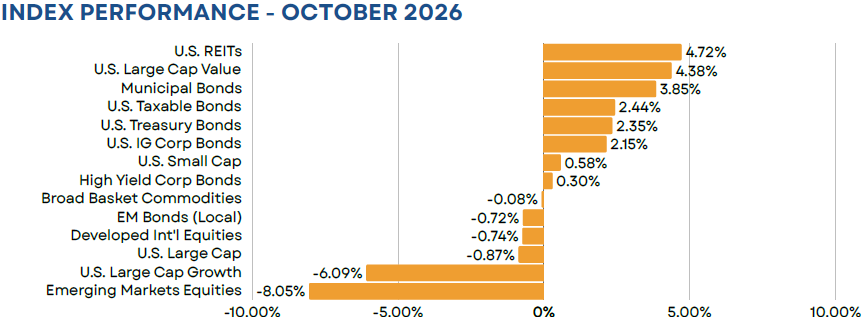
Equity markets experienced a notable change in leadership during October, as concerns surrounding artificial intelligence valuations weighed on large cap technology stocks. Although the S&P 500 declined 0.87%, performance beneath the surface was considerably stronger, with the equal-weighted index gaining 5%. Value stocks and small caps also outperformed, highlighting a broadening of market participation. International equities were generally weaker, particularly emerging markets, where significant exposure to technology companies contributed to a sharp decline. Fixed income, however, was among the stronger performing asset classes, as declining treasury yields provided a tailwind to bond prices. The Bloomberg U.S. Aggregate Bond Index gained 2.44%, marking a meaningful reversal from the losses experienced during the third quarter. Conversely, commodities were generally flat, as strength in energy prices was offset by weakness in precious metals.
Equity
Equity markets experienced a sharp rotation during October, as weakness among large cap technology and AI-related companies contrasted with strength across much of the broader market. Although the S&P 500 declined 0.87%, more than 70% of its constituents finished the month in positive territory. This highlights the extent to which weakness in a handful of large companies can impact a market-cap-weighted index. Not surprisingly, the Russell 1000 Growth was a laggard on the month, falling more than 6% as investors increasingly questioned the substantial capital expenditures associated with artificial intelligence and the timeline for generating returns on those investments. Meanwhile, the Russell 2000 gained roughly 0.6% and the FTSE NAREIT Index advanced nearly 4.72%, reflecting broader strength beyond mega cap technology.
Outside of the U.S., developed international stocks posted modestly negative results, declining approximately 0.8% in USD-terms. Conversely, emerging markets equities experienced a much more difficult month, declining approximately 8%. From a country standpoint, Korea and Taiwan were among the largest detractors, as their significant exposure to semiconductor and technology companies left them particularly vulnerable to the broader reassessment of AI-related investment.
Fixed Income
Fixed income markets rebounded during October as softer labor market data and increased equity market volatility led investors to safe haven assets. The Bloomberg U.S. Aggregate Bond Index gained approximately 2.4%, as yields fell across the curve. The 10-year Treasury yield declined from roughly 5.29% at the end of September to 4.93% by month-end, while the 30-year yield fell to approximately 5.31%. On the policy front, the Federal Reserve left its benchmark policy rate unchanged, as expected, although policymakers continued to emphasize that inflation remained elevated.
Credit markets also advanced as declining treasury yields provided a tailwind to fixed income securities. Investment grade corporate bonds gained 2.15%, while high yield bonds posted a more modest gain of 0.3%. Credit spreads widened during the month, as investors became increasingly selective amid concerns surrounding financing conditions and the substantial capital requirements associated with AI infrastructure. Municipal bonds were a standpoint performer during the month, logging a gain of nearly 4%. This was a much welcomed rebound for muni investors who saw the index decline by more than 4% in September, amid concerns around rising interest rates and a likely surge in tax loss selling.
Real Assets
Real assets delivered mixed results during October, as continued strength in energy prices was offset by weakness in precious metals. The Bloomberg Commodity Index was generally flat for the month, despite a significant increase in oil prices. WTI crude rose roughly 15%, as renewed geopolitical tensions in the Middle East increased concerns about disruptions to global energy supplies. Precious metals, however, were considerably weaker. Gold declined by 7%, as a stronger dollar and continued pressure from elevated interest rates weighed on the metal. This came despite increased volatility across equity markets, where investors sought out treasuries as their safe haven rather than precious metals.
Closed End Funds
Closed end funds experienced a generally favorable environment during October as declining treasury yields helped support underlying fixed income portfolios. However, market volatility and continued uncertainty surrounding credit conditions did little to move discounts. The average fund ended the month trading around 7.5% below NAV, while the average taxable fixed income fund traded at an 8.3% discount.
iCM Strategy Performance
iCM’s Tactical strategies, which utilize ETFs and/or mutual funds, exhibited mixed performance relative to their benchmarks. Our fixed income strategy produced positive absolute returns, but lagged its benchmark due to our allocation to emerging markets local bonds. However, the equity strategy performed well on both an absolute and relative basis, producing a positive monthly return despite a decline for its benchmark. Returns were supported by a sizable overweight to U.S. value stocks across the market cap spectrum, as well as an allocation to REITs.
iCM’s Tactical Income strategies, which include TICE and TAO, saw mixed results on the quarter. TICE performed generally in line with its benchmark as strong performance from our municipal CEF holdings was offset by weakness in emerging markets equity and debt. The TAO strategies modestly underperformed due to our overweight to non-U.S. assets.
Important Disclosures
Integrated Capital Management, Inc. is an SEC Registered Investment Advisor. Registration does not imply any certain level of skill or training. Monthly “Market Flash” is intended solely to report on various investment views held by Integrated Capital Management. Opinions, estimates, forecasts, and statements of financial market trends that are based on current market conditions constitute our judgment and are subject to change without notice. We believe the information provided here is reliable but should not be assumed to be accurate or complete. References to specific securities, asset classes and financial markets are for illustrative purposes only and do not constitute a solicitation, offer or recommendation to purchase or sell a security.
Past performance is no guarantee of future results. Please note that investments in foreign markets are subject to special currency, political, and economic risks. Index performance returns do not reflect any management fees, transaction costs or expenses. Indexes are unmanaged and one cannot invest directly in an index. Asset Allocation Outlook is intended solely to report on various investment views held by Integrated Capital Management. Opinions, estimates, forecasts, and statements of financial market trends that are based on current market conditions constitute our judgment and are subject to change without notice. We believe the information provided here is reliable but should not be assumed to be accurate or complete. References to specific securities, asset classes and financial markets are for illustrative purposes only and do not constitute a solicitation, offer or recommendation to purchase or sell a security. Outlook may change at any time given shifting market conditions. Past performance is no guarantee of future results. Please note that investments in foreign markets are subject to special currency, political, and economic risks. Index performance returns do not reflect any management fees, transaction costs or expenses. Indexes are unmanaged and one cannot invest directly in an index.
Closed end funds are exchange traded, may trade at a discount to their net asset values and may deploy leverage. When the strategy purchases shares of a closed-end fund at a discount to its net asset value, there can be no assurance that the discount will decrease and may possibly increase. If a closed-end fund uses leverage, increases and decreases in the value of its share price may be magnified. Distributions by a closed-end fund may include a return of capital, which would reduce the fund’s net asset value and its earnings capacity. Closed end funds are offered by prospectus. The prospectus and/or other applicable offering documents contain this and other important information about the investment strategy. You should read the prospectus and/or other applicable offering documents carefully before investing. Investors should consider the investment objectives, risks, charges and expenses of the investment strategy before investing. iCM uses third-party data that is believed to be accurate and complete. All data is subject to change. All investing involves the assumption of risk and the possible loss of principal. The main risks as it pertains to iCM’s strategies are US equity risk, international equity and fixed-income market risk, interest rate risk and currency risk. While attempting to achieve the objectives of the strategies, investors will be exposed to the risk of loss from these sources along with others yet to be identified.