With our elections right around the corner, there is often uncertainty about how a change in political leadership could impact the markets. History suggests the relationship between government control and investment returns may be more nuanced than headlines imply.
Since 1871, periods of unified government (when the same political party controls the White House and both chambers of Congress) have produced average 2-year annualized returns of 8.2% for the S&P 500, compared with 5.8% during periods of divided government. At first glance, these figures appear to favor unified government.
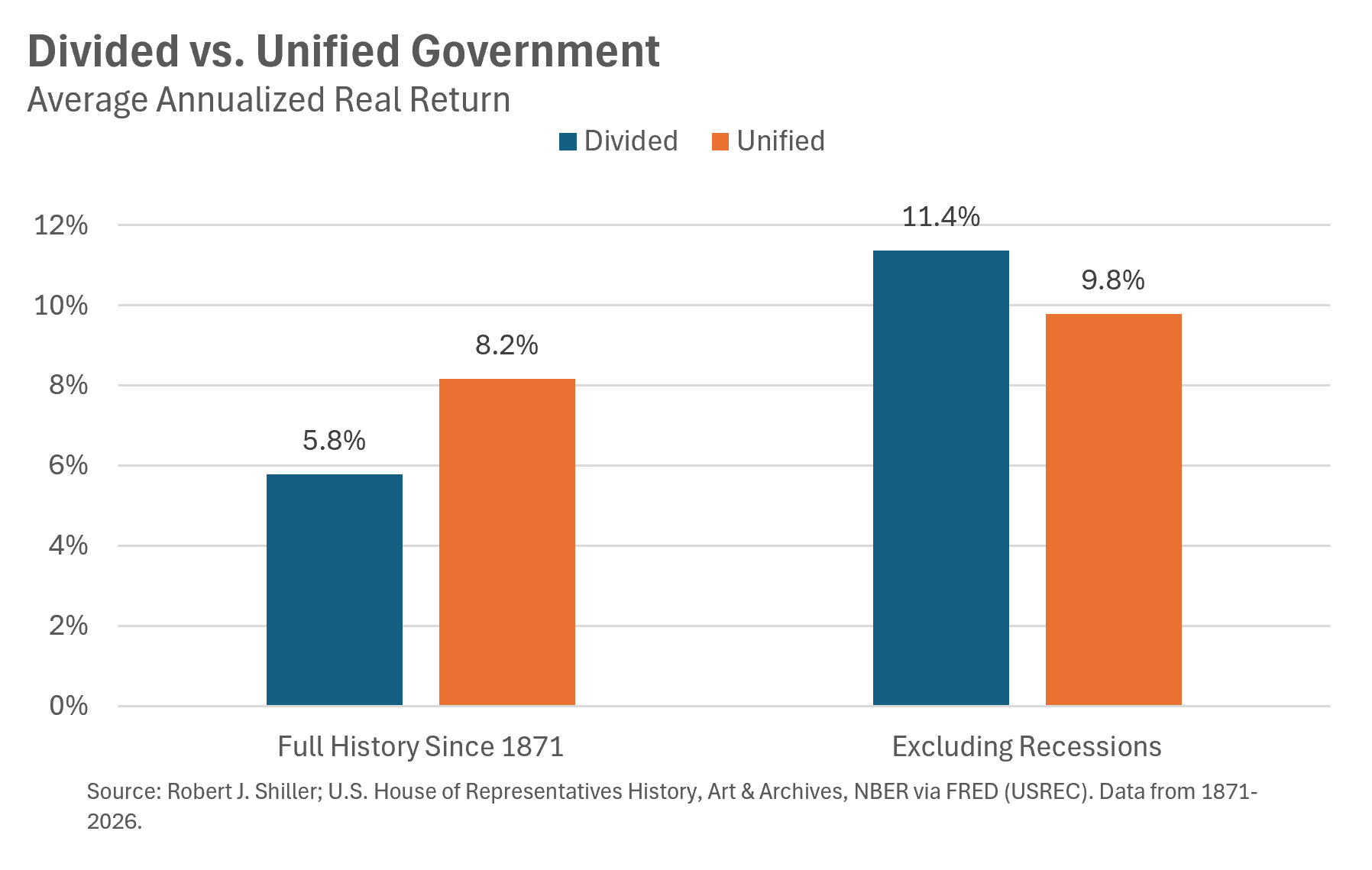
However, the picture changes when recessions are excluded. During expansions, divided government has produced 11.4% 2-year annualized returns, compared with 9.8% under unified government over the same time period. This distinction highlights an important consideration - market performance is influenced by far more than election outcomes, or which party controls Washington. Economic growth, inflation, interest rates, corporate earnings, investor expectations and valuations all play significant roles in shaping returns. Recessions, in particular, can have an outsized impact on long-term averages and may help explain the differences between these historical results.
The takeaway? Political control alone is not a reliable predictor of future market performance.
While elections can create short-term volatility as investors assess potential policy changes, making investment decisions based solely on political outcomes risks overlooking the broader economic and market forces that ultimately drive portfolio outcomes. Rather than trying to position a portfolio around election results, investors may be better served by maintaining a disciplined, valuation-conscious investment approach that adapts to changing market conditions and remains focused on long-term objectives.
Disclosures
Integrated Capital Management, Inc. is an SEC Registered Investment Advisor. Registration does not imply any certain level of skill or training. This blog is intended solely to report on various investment views held by Integrated Capital Management. Opinions, estimates, forecasts, and statements of financial market trends that are based on current market conditions constitute our judgment and are subject to change without notice. We believe the information provided here is reliable but should not be assumed to be accurate or complete. References to specific securities, asset classes and financial markets are for illustrative purposes only and do not constitute a solicitation, offer or recommendation to purchase or sell a security.
Past performance is no guarantee of future results. Please note that investments in foreign markets are subject to special currency, political, and economic risks. Index performance returns do not reflect any management fees, transaction costs or expenses. Indexes are unmanaged and one cannot invest directly in an index. Where applicable, portfolio characteristics are shown gross of fees.
Any capital markets views are intended solely to report on various investment views held by Integrated Capital Management. Opinions, estimates, forecasts, and statements of financial market trends that are based on current market conditions constitute our judgment and are subject to change without notice. We believe the information provided here is reliable but should not be assumed to be accurate or complete. References to specific securities, asset classes and financial markets are for illustrative purposes only and do not constitute a solicitation, offer or recommendation to purchase or sell a security. Outlook may change at any time given shifting market conditions. Past performance is no guarantee of future results. Please note that investments in foreign markets are subject to special currency, political, and economic risks. Index performance returns do not reflect any management fees, transaction costs or expenses. Indexes are unmanaged and one cannot invest directly in an index.
Closed end funds are exchange traded, may trade at a discount to their net asset values and may deploy leverage. When the strategy purchases shares of a closed-end fund at a discount to its net asset value, there can be no assurance that the discount will decrease and may possibly increase. If a closed-end fund uses leverage, increases and decreases in the value of its share price may be magnified. Distributions by a closed-end fund may include a return of capital, which would reduce the fund’s net asset value and its earnings capacity. Closed end funds are offered by prospectus. The prospectus and/or other applicable offering documents contain this and other important information about the investment strategy. You should read the prospectus and/or other applicable offering documents carefully before investing. Investors should consider the investment objectives, risks, charges and expenses of the investment strategy before investing. iCM uses third-party data that is believed to be accurate and complete. All data is subject to change.
FTSE NAREIT All Equity REITs TR = U.S. REITs
S&P 500 Index = U.S. Large Cap
Russell 1000 Growth TR = U.S. Large Growth
Russell 1000 Value TR = U.S. Large Value
Russell 2000 Index = U.S. Small Cap
MSCI EAFE ND USD = Developed International Equities
Bloomberg High Yield Corp Bond = High Yield Bonds
Bloomberg Municipal TR = Municipal Bonds; BBgBarc
Bloomberg US Credit TR = U.S. IG Corp Bonds
Bloomberg Aggregate Bond = U.S. Taxable Bonds
Bloomberg Treasury TR = U.S. Treasury Bonds
MSCI Emerging Markets ND USD = Emerging Markets Equities;
JPM GBI EM Glbl Divers TR = EM Bonds;
Bloomberg Commodity TR USD = Broad Basket Commodities
First Trust Composite Closed-End Fund TR Index = Closed End Funds
Use or publication of this material is prohibited without the express written consent of Integrated Capital Management, Inc.
(MMXXVI)